Wednesday, December 7, 2011

Gingerbread Men

     It is Gingerbread Man week in our class.  We will be reading many different versions of the story.   We will compare how the stories are alike and different by looking at the story elements - characters, setting, problem and ending.  Yesterday we started with the book by Karen Schmidt.


     After reading the story, we sequenced, drew and labeled the characters on our own papers.

     Today our book was, The Gingerbread Boy by Paul Galdone.  We then compared it with the story from yesterday.  The students were quick to point out that the characters and ending were different from the Schmidt version of the story. 

     We started writing our own books about the gingerbread man.  Students are using the frame, "I can run from a _____".  They are responsible for writing all the words and illustrating the pictures. 


Holidays Around the World

We started our unit, Holidays Around the World, in our own country. The activity pages for this unit were stapled into a file folder. A cardboard handle was added to the top so the file looks like a small suitcase. The students drew red stripes on the handle to make it look like a candy cane.


We began the unit by discussing the traditions our own families honor. It was decided that most of our families put up a Christmas tree, hang our stockings, exchange gifts and have a visit from Santa.

In our "suitcase" we found the United States on a world map and colored it in. On the next page was a map of the United States where we found our state of Colorado and colored it.

We looked at our U.S. flag and talked about how it looked. The students were excited to notice that our flag has a pattern on it. (Since our math unit on patterns, we have been finding patterns every where!)

Today we began talking about the holiday traditions and customs of Germany. On the Promethean board, I used Google Earth to show the children where we were in Colorado. Then we flew across the ocean and landed in Germany. What a great tool to visualize traveling around the world!

Our class learned that the Christmas tree  originated in Germany and is called the tannenbaum. Families gather together and enjoy baking together. One of the favorite cookies to make is gingerbread. Therefore, this week our class will be participating in many gingerbread men and Christmas tree activities.

In our suitcase of activity pages, we found Germany on our world map. Our word this week is compare.  So we compared our country to Germany and noticed that Germany is smaller than the United States. To color in the Germany flag, we had to research on the internet what colors to use because no one knew.

I am surprised and excited about how interested the students are in their maps and flags. One little guy chose to finish coloring his flag instead of going to recess. Now that is something!

In math, we started our new unit on measuring. We traced our shoe and cut out the shoe print. The students then measured how many unifex cubes long their print was. They had to record their answer.  We then exchanged shoe prints, and we measured someone else's print.  Using our word compare again, we compared our prints to see which one was longer, smaller or just the same.

Sunday, December 4, 2011

Reindeer & Count Down Chain

      We started off the holiday season by studying about reindeer.  We learned many interesting facts about real reindeer.  On the first page of our book, we cut apart and put back together the sentence, "Reindeer are mammals."  Mammal was a new word for us, so we had to research and find out what the word meant.

      On the second page of our book, the students chose their favorite fact about a reindeer and wrote it, being very careful to sound out each word.  On the last page, we used different shapes to draw reindeer.


     Together we labeled the parts of a reindeer.
      

      The students were then given their own paper where they could label the reindeer.

      To make a reindeer, we traced our foot for the face and traced out hands to make the antlers.  We glued these pieces onto a stuffed paper bag and added accordion legs.  These are the cutest reindeer!


       After the students created this cute paper bag reindeer, they wrote a fiction story about their special magic reindeer.

      On the first day of the month, we made a classic Kindergarten holiday tradition - a red and green paper chain.  Twenty-four links are on our chain so we can count down the days until Santa arrives.  The students were very excited and proud of their long, pattern, count down chains.  They all worked very hard to complete all the links.


Sunday, October 30, 2011

Pumpkins & Mummies


     Our poem for this week was Five Little Pumpkins.  The students love this poem and would break out chanting the poem all on their own at times during the day.  They loved creating their own pumpkins for our fence.


     We are learning to use our sounds to spell words.  The best place to start with this skill is in labeling.  Here is a picture of our class labeling a pumpkin together.


During our lessons on the life cycle of a pumpkin, our class read the book, Pumpkin Jack


     This is a book about a boy who puts his pumpkin out in the garden.  Over the seasons, he watches the pumpkin change.  In the Spring, he finds that Pumpkin Jack has rotted and produced lots of other new pumpkins.

     After reading the story, the students decided that they wanted to observe what our pumpkin would do over time.  We already had a plastic box full of dirt where we had planted seeds.  So we put our Pumpkin Jack in the box and covered it with a lid so it wouldn't stink in our classroom.   We predicted that over time our pumpkin would rot.  We have been recording our observations each day of what Pumpkin Jack looks like.

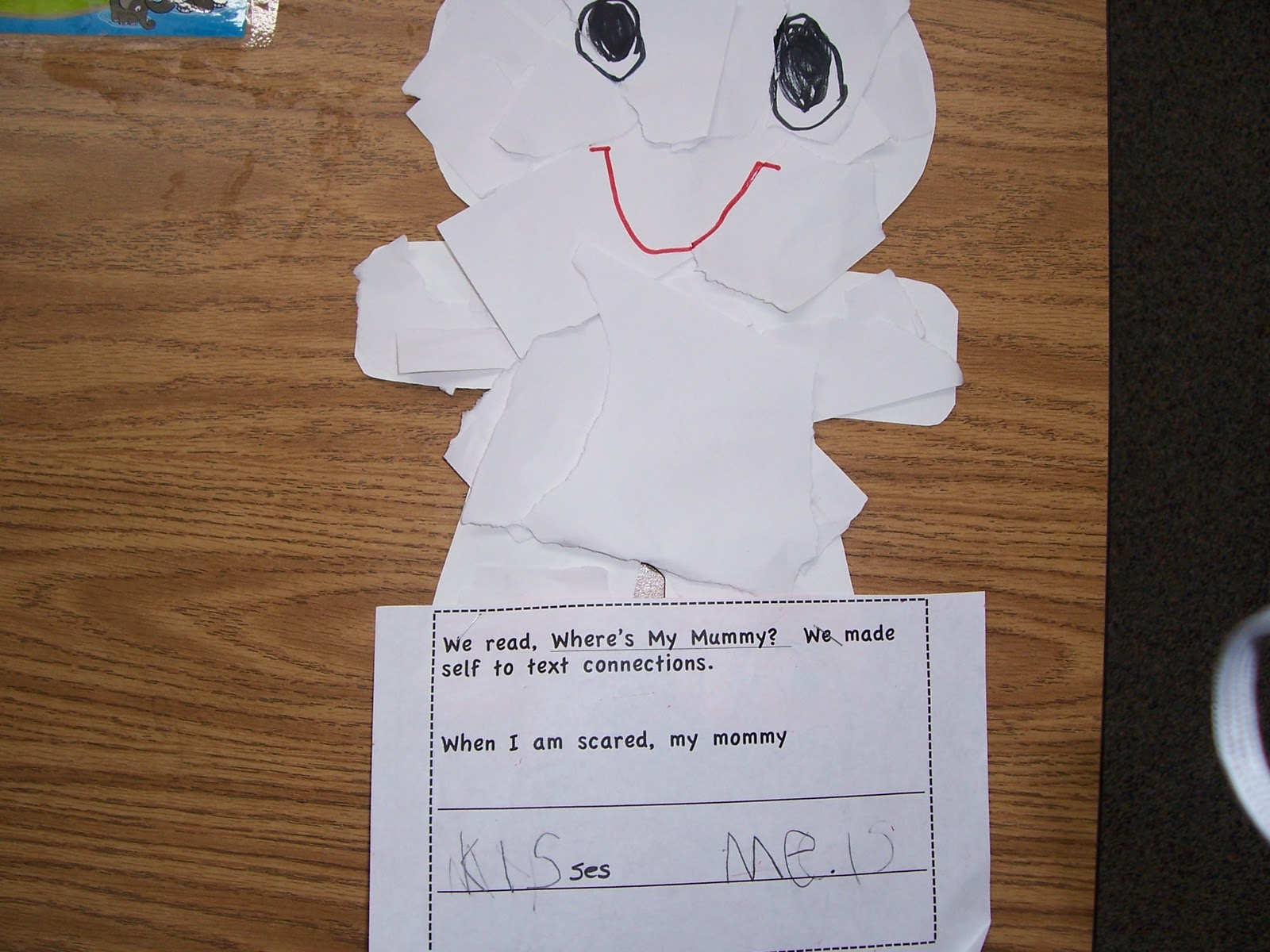
      This fun science activity came from Mrs. Jump's blog.  Our class also used her ideas for the book, Where's My Mummy?  

    Our class is working on naming characters and their characteristics in books.  This was a good book to practice this particular skill.  We focused on Baby Mummy and how he looks, what he does and how he feels.


     Together we completed a chart with the frame, "When I'm scared, my mommy _____."  This helped us make connections to complete our own frame on our paper.  The best part was making our own Baby Mummy.


     On Friday we wrote our first book!  We titled our book, I See.  While writing the books, our authors practiced creating text, sounding out words, locating words in the room and copying them for their story, letter formation and illustrations.  They are very proud of their books, and I am proud of the work they accomplished on the first book they authored and illustrated. 

     In math, we are working on ordering numbers.  When given 4 different numbers, the child should be able to put them in order from the smallest to largest number.  

      In class, we played a card game, called Compare or Snap,  which you can easily play at home.  Use number cards 0 through 10.  Shuffle the cards, place them face down.  Each person turns the top card over and compares the numbers on his/her cards to see which number is greater and which number is less.  Whoever has the greater number says, "snap" and gets to have both cards.

     Next week, we will be talking about scarecrows!


Tuesday, October 18, 2011

Pumpkins

     It's a week about pumpkins!  Our class started the week making a KWL chart about pumpkins.  We listed what we already knew about them (our schema). 


     We learned about the life cycle of a pumpkin.  From seed, to vine, to blossom to green pumpkin to orange pumpkin and back to seeds, the cycle goes round and round.  We compared the pumpkin to the life cycle of an apple.

     We measured the circumference of a pumpkin.  First we predicted what we thought the size of his belt might be and cut a piece of yarn that predicted size.  Then we actually tested our yarn to see if it was too short, too long or just the right size for the pumpkin's belt (circumference).  Everyone in our class guessed too short.


     We worked on our observation skills using a pumpkin.  Before we cut it open, we had to draw what our pumpkin looked like, predict what it might look like inside, and guesstimate how many seeds we thought might be inside.  There were some interesting guesses.  All the way from five seeds to one thousand seeds were estimated.  We were surprised to find that there were about 300 seeds inside our pumpkin.

     When cutting out the jack-o-lantern, we were sensitive to our five senses.  Our favorite was the sense of touch when we helped scoop out the gooey pulp inside.  

     Hands on activities are the best things in kindergarten!  So what better way to observe the pumpkin life cycle than by planting pumpkin seeds and watching to see if they will grow over the next couple of weeks?

     Our families completed the At Home "Decorate A Pumpkin" Family Project.  Any materials could be used to decorate a paper pumpkin, and a story was to be written about the newly created pumpkin.  We had some terrific projects and stories returned to school.  Thank to all the families for your help!


Wednesday, October 12, 2011

Apple Days

     It has been a busy week full of apple activities.  Look at all the fun learning things we have participated in!

     * illustrated the life cycle of an apple


     * listened to a story about a little red house with no doors, no windows and had a star inside

     * cut open an apple and found the star inside

     * printed the star


     * read the book, Ten Apples Up On Top and created our own class book


     * drank apple juice, ate apple slices and apple sauce

     * graphed "how do you like your apples?"

     * used our fine motor skills to tear paper to create an apple


     * learned how to spell the word "apple"

     * learned poems, chants, and songs about apples

     * created patterns, sorted and counted apples

     * added the mini book, The Apple Tree to our book boxes


See?  It has been a busy week of learning in Kindergarten!


Tuesday, October 11, 2011

Life Cycle of an Apple

      Today we learned about the life cycle of an apple.  From seeds, to a trees, to blossoms to apples and back to seeds, the cycle is never ending.  Our class illustrated the cycle.

      We are learning how we can use our 5 senses to investigate apples.  We used all our senses today when we ate apple slices.  We looked at the slice very closely with our eyes, felt it, smelled it and of course, tasted it and listened to the crunching noise the apple made as we bit into it.

      Allie Alligator came to class today and brought the letter A.  We learned how to write the letter and learned the two sounds the vowel A makes.  When we used our nursery rhyme, Humpty Dumpty for word work, we were terrific detectives and found all the letter Aa's and highlighted them. 
    
       In math, we had apples with the numbers 0 - 10 on them.  After cutting them out, we put them in order and played a game called, "show me".  Show me the number 8.  Show me the number 3.  When we were finished, we put the numbers in order one more time on our paper and glued them down.

      We are trying very hard to learn our numbers 0 - 10.  Any practice you can give your child at home will help them achieve this target.